Evolution of life on earth
Human evolution
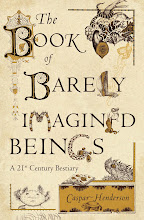
A 21st Century Bestiary
O how many times were you seen among the waves of the great swollen ocean, looming like a mountain, defeating and overwhelming them, and with your black and bristly back furrowing the sea waters, and with stately and grave bearing! [1]-- from Exactitude, one of Six Memos for the Next Millennium by Italo Calvino (1985).
Somehow the more we learn about whales, the more we’re coming to appreciate the sublimely discomfiting reality that a kind of parallel “us” has long been out there roaming the oceans' depths, succumbing to our assaults.-- from Watching whales watching us by Charles Siebert.

Thank goodness we’ve gone through a kind of cognitive revolution when it comes to studying the intelligence and emotion of other species. In fact, I’d say now that it is my obligation as a scientist not to discount that possibility. We do have compelling evidence of the experience of grief in cetaceans; and of joy, anger, frustration and distress and self-awareness and tool use; and of protecting not just their young but also their companions from humans and other predators. So these are reasons why something like forgiveness is a possibility. And even if it’s not that exactly, I believe it’s something. That there’s something very potent occurring here from a behavioral and a biological perspective. I mean, I’d put my career on the line and challenge anybody to say that these whales are not actively soliciting and engaging in a form of communication with humans, both through eye contact and tactile interaction and perhaps acoustically in ways that we have not yet determined. I find the reality of it far more enthralling than all our past whale mythology.-- Toni Frohoff as quoted by Siebert.
The presence of mental images and their use by an animal to regulate its behavior, provides a pragmatic working definition of consciousness.from D.R.Griffin on The Question of Animal Awareness (1976) - one of many definitions of consciousness

It may be that all the particles [in the universe] we see were originally collected into a small dense region because it is easier to create a new bubble universe in such a configuration than it is to make a large, dilute universe from scratch. The growth of entropy in our observable universe, and the corresponding arrow of time [without which life -- metabolism, reproduction, evolution, memory -- would not exist], may be a reflection of the larger multiverse's insatiable desire to create ever more entropy by giving birth to new baby universes. If we could just have an angel's-eye view of the entire ensemble, it might all look quite natural.-- from Our Place in an Unnatural Universe by Sean Carroll, included in What's Next? Dispatches on the Future of Science.
Or perhaps not...[But] the universe is certainly trying to tell us something; it's our job to attempt to make out what it's saying as best we can.
Image: the Antennae galaxies.
The tretretretre is a large animal, like a calf of two years, with a round head and the face of a man. The forefeet are like those of an ape, as are the hindfeet. It has curly hair, a short tail, and ears like a man's...It is a very solitary animal; the people of the country hold it in great fear and flee from it, as it does from them.-- this is a Megaladapis as described by Étienne de Flacourt in his Histoire de la Grande Isle de Madagascar of 1661 (and quoted in A Pleistocene Bestiary).
Image from the Atlas Virtual da Pré-História.
Somehow, this single-celled organism [Physarum polycephalum] had memorised the pattern of events it was faced with and changed its behaviour to anticipate a future event. That's something we humans have trouble enough with, let alone a single-celled organism without a neuron to call its own.-- Slime mold to DARPA: Justin Mullins on the future of artificial intelligence.
... [Max] Di Ventra speculates that the viscosities of the sol and gel components of the slime mould make for a mechanical analogue of memristance. When the external temperature rises, the gel component starts to break down and become less viscous, creating new pathways through which the sol can flow and speeding up the cell's movement. A lowered temperature reverses that process, but how the initial state is regained depends on where the pathways were formed, and therefore on the cell's internal history.
In true memristive fashion, [Leon] Chua had anticipated the idea that memristors might have something to say about how biological organisms learn. While completing his first paper on memristors, he became fascinated by synapses - the gaps between nerve cells in higher organisms across which nerve impulses must pass. In particular, he noticed their complex electrical response to the ebb and flow of potassium and sodium ions across the membranes of each cell, which allow the synapses to alter their response according to the frequency and strength of signals. It looked maddeningly similar to the response a memristor would produce. "I realised then that synapses were memristors," he says. "The ion channel was the missing circuit element I was looking for, and it already existed in nature."
We can see the beginning of an era of enlightenment for slime molds...the day may come where we may hail Alan Turing, along with his other claims to fame as the Robert MacArthur of developmental biology...[but] we still have a long -- and interesting way to go. And the reason we all started working on cellular slime molds is that they were supposed to be so simple!
A study of what the Arctic looked like just before dinosaurs were wiped off the planet has provided a glimpse of what could be to come within decades.
The Rough-legged hawk of Minerva flies at dusk.
Without wanting to get mystical about it, fire is, in many respects, a kind of animal, albeit an ethereal one. Like any animal, it consumes oxygen. Like a sheep or a slug, it eats plants. But unlike a normal animal, it’s a shape-shifter.-- Olivia Judson. Mystical? No. A comparison of limited value? Yes. Still, the idea grips the imagination; fire as a 'vital spark' has a long history.
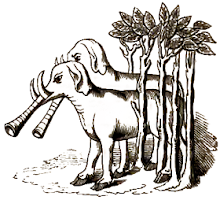
GB 190408713 for an acrobatic apparatus. A device for projecting horses, elephants, monkeys, &c. into the air so that they turn a somersault.
David Attenborough joined scientists today to warn that carbon dioxide in the atmosphere is already above the level which condemns coral reefs to extinction, with catastrophic effects for the oceans and the people who depend upon them.If this analysis is correct then one of the few options left would to be scrub very large amounts of CO2 out of the atmosphere. But that doesn't look a likely prospect, does it?
Ever inclined to make an inscription, human beings have figured out how to write their own messages in the heart of the [otolith]. By sequentially altering the temperature of the water in which salmon fry are hatched and raised, researchers can lay a distinctive “batch label” into the chemical layers of the otolith—a kind of barcode, inscribed in stone, and indelibly preserved within the maturing adult fish (a puckish early student of this technique used it to write “hi mom” in binary inside his experimental animal). Later, when these free-swimming creatures are captured at sea, each can be traced unfailingly to its hatchery of origin. Some five billion Pacific salmon have now been marked in this way, their inner qibla reconfigured to refer to their point of origin, and thus the point to which they seek return.from The Orienting Stone
Malu maluAs may be guessed from the author profile picture for this blog, the thought causes a twinge.
You marvel that this mater, shuffled pell-mell at the whim of chance could have made man, seeing that so much was needed for the construction of his being. But you must realize that a hundred million times this matter, on the way to human shape, has been stopped to form now a stone, now lead, now coral, now a flower, now a comet; and all because of more or fewer elements that were or were not necessary for designing a man. Little wonder if, within an infinite quantity of matter that ceaselessly changes and stirs, the few animals, vegetables and minerals we see should happen to be made; no more wonder than getting a royal pair in a hundred casts of the dice. Indeed it is equally impossible for all this stirring not to lead to something; and yet this something will always be wondered at by some blockhead who will never realise how small a change would have made it into something else.-- from Voyage dans la lune (1661) by Cyrano de Bergerac, quoted in Lightness, one of Six Notes for the Next Millennium (1985) by Italo Calvino.

Image by Johannes Kepler, 1611.
Seagrass meadows are being lost at rate of "comparable to that for tropical rainforests and coral reefs."-- from Meadows of the sea in 'shocking' decline
They protect[ed] edible crustaceans, like shrimps and crabs, and juvenile fish such as salmon. In addition, seagrass meadows provide[d] habitats for endangered species like dugongs, manatees, and sea turtles.